Arizona National Guard Gets First Gray Eagle 25M, Reshaping State-Level Surveillance Reach
The Gray Eagle 25M's arrival in Arizona marks a generational shift in what a state-level force can accomplish over contested terrain — and it raises serious questions about how other border states will respond.
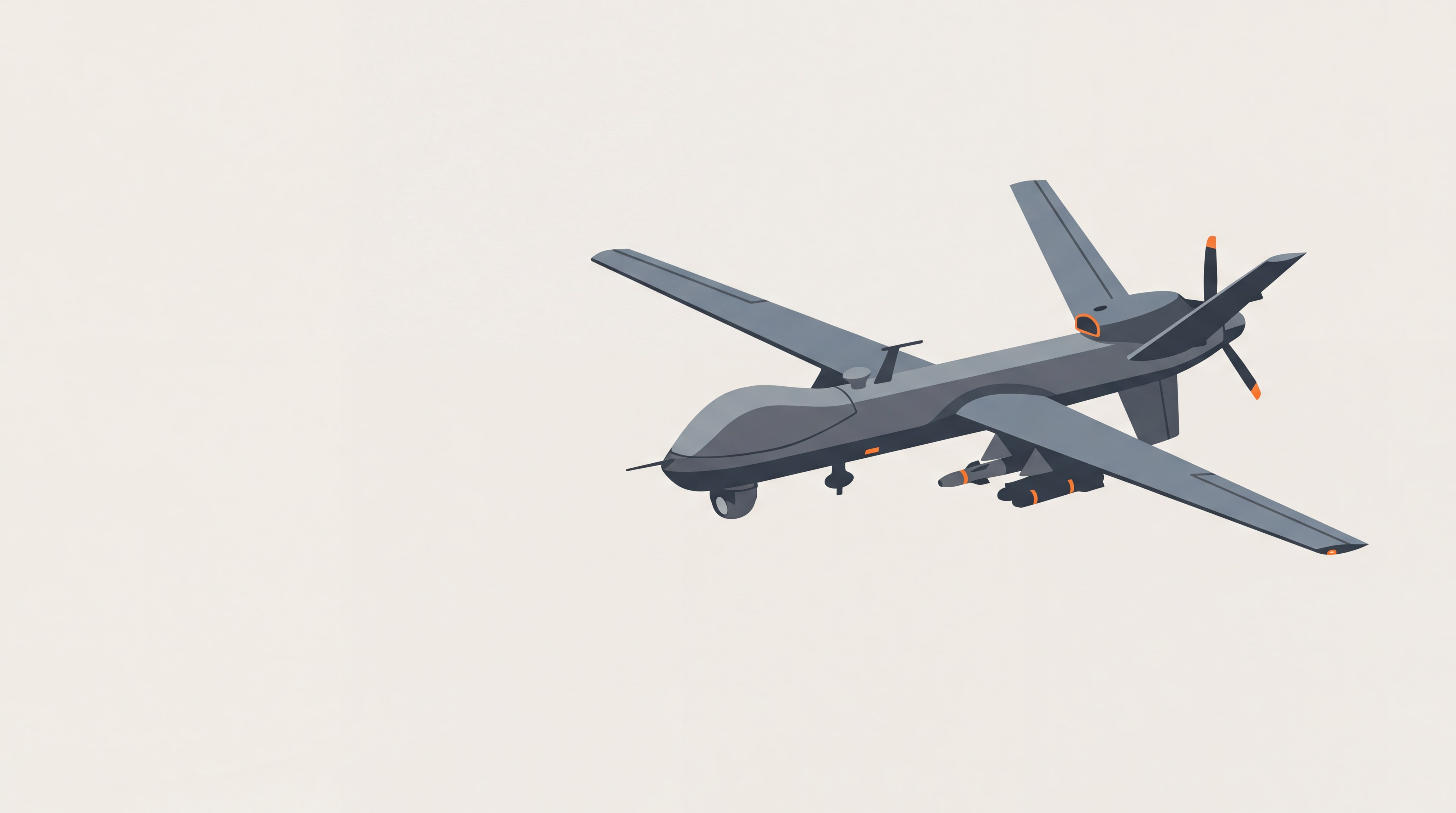
At a hangar on an Arizona National Guard installation, the outline of a Gray Eagle 25M sits beneath overhead lighting that catches the length of its wing. It is larger than most visitors expect. For the soldiers and airmen who will operate it, that size is the point — more wing means more fuel, more altitude, and more time over target than any predecessor system the state has fielded.
The Arizona National Guard has been designated the first state-level unit to achieve First Unit Equipped status with the Gray Eagle 25M, a distinction that makes Arizona the testing ground for how a National Guard formation absorbs and operationalises a system previously associated with active-duty and federal missions. That designation carries weight well beyond state lines.
What the 25M Designation Actually Means
The Gray Eagle 25M — sometimes referred to as the GE25M, or by its broader MQ-1C lineage — represents a modernisation package built around an upgraded engine and enhanced power generation architecture. The 'M' signals modernisation, and in practical terms it translates to extended operational range and the ability to carry a heavier, more capable sensor payload without sacrificing endurance.
Where earlier Gray Eagle variants were already capable of multi-hour missions, the 25M's power improvements allow operators to sustain longer dwell times over a fixed area of interest — a capability that matters enormously in the context of wide-area persistent surveillance. The system's sensor suite includes synthetic aperture radar, or SAR, and ground moving target indicator, known as GMTI, capabilities. Those two technologies together allow operators to detect stationary features and track moving objects simultaneously, across conditions that would ground or blind optically dependent systems.
For procurement officers and operations managers evaluating the platform against legacy systems currently in state inventories, the comparison is not subtle. Earlier medium-altitude, long-endurance platforms in Guard service have offered meaningful surveillance windows, but not the combination of range, power availability, and sensor fidelity that the 25M brings to the same mission profile.
Operational Reach Along the Southwest Corridor
The geography of Arizona is itself an argument for the platform. The state shares a substantial international border and contains terrain that ranges from dense urban periphery to remote mountain corridors and open desert — environments that punish rotary-wing assets with heat and altitude, and that demand the kind of persistent overhead presence that only a long-endurance fixed-wing UAS can reliably provide.
"What changes is the timeline," one Guard leadership figure indicated in discussions around the programme. When a system can remain airborne through an entire operational period without rotation, the gaps that previously existed in coverage — gaps that experienced adversaries learn to exploit — close in ways that no scheduling improvement on a shorter-range platform could replicate.
For border security specifically, the 25M's long-dwell capability enables what operators describe as persistent wide-area surveillance: the ability to maintain continuous sensor coverage over a defined zone, hand off to another orbit, and build an intelligence picture over time rather than in discrete snapshots. The GMTI function is particularly relevant here, flagging movement patterns and allowing ground-based response elements to position ahead of an event rather than react to one.
Inside the Ground Control Station
From the ground control station, the operator interface on the 25M reflects a broader industry direction toward reduced cognitive workload during extended missions. AI-assisted navigation and machine vision functions absorb routine monitoring tasks — altitude maintenance, sensor orientation, route adherence — freeing the crew to focus on the intelligence picture rather than the mechanics of keeping the aircraft aloft.
For a state unit that will not have the same crew depth as a large active-duty organisation, this reduction in operator workload is not a convenience feature. It is a force multiplier. A smaller trained cadre can sustain longer operational cycles when the platform is doing more of the routine work autonomously.
"The system manages more of the flight envelope on its own," one operator-level source noted. "That lets us stay focused on what the sensors are telling us, not on managing the aircraft minute to minute."
State Command, Federal Coordination
The First Unit Equipped designation also surfaces a set of questions that are distinct from anything a federal unit acquiring the same platform would face. A state-managed GE25M unit operates under the authority of the state's governor in non-federalised status, which shapes the legal and operational framework for every mission it flies. Coordination with federal agencies — Customs and Border Protection, the FBI, and others with equities in the border zone — requires clear interoperability protocols that state-level planners are working to establish ahead of full operational capability.
Interoperability extends to data. The SAR and GMTI feeds the 25M generates are only as useful as the ability to push them to the right consumers in near-real time. Establishing those data pipelines between a state Guard unit and federal law enforcement partners is a planning problem as much as a technical one, and Arizona's experience solving it will inform every state that follows.
A Blueprint in the Making
The Guard leadership's characterisation of this deployment as a capability step-change is supported by the platform's specification profile, but the more consequential outcome may be institutional. Arizona is not simply receiving hardware — it is building the doctrine, the training pipeline, the maintenance posture, and the interagency relationships that a long-range persistent UAS mission requires at state level.
Other border states are watching. The questions their procurement teams are already asking — about basing, about crew certification timelines, about how GMTI data integrates with existing command systems — are questions Arizona will be able to answer from operational experience rather than theory.
The era of persistent, long-range autonomous surveillance at the state level has not merely arrived on a specification sheet. It has arrived in a hangar in Arizona, on an aircraft that is longer than most people expect, with a sensor suite that does not stop watching when the shift changes.
Cite this article
Rob Polli. "Arizona National Guard Gets First Gray Eagle 25M, Reshaping State-Level Surveillance Reach." Autonomous Systems Review, 17 Oct 2026. https://autonomoussystemsreview.com/articles/arizona-national-guard-gets-first-gray-eagle-25m-reshaping-state-level-surveilla.