Sector briefing: drone delivery just had its most consequential week
Three announcements in roughly 24 hours — DoorDash's Part 135 certificate, Walmart's Florida return and Flytrex's multi-modal play — mark the moment US drone delivery stopped being a pilot programme and started being logistics.
For most of a decade, drone delivery news followed a template: a pilot, a press release, a quiet wind-down. The last week of July broke the template. Three announcements landed in the space of a day, and each one signals a different bet on how the economics of aerial last-mile will actually work.
DoorDash builds the airline
DoorDash launched DoorDash Air after securing a Part 135 air carrier certificate from the FAA — making it only the eighth drone operator in the United States to hold one. The certificate permits beyond-visual-line-of-sight flight below 400 feet, and it changes DoorDash's legal character entirely: the company is no longer a marketplace buying drone capacity from Wing and Flytrex, but a regulated air carrier with its own maintenance programmes, operating procedures and safety systems to uphold.
The aircraft itself — American-built, designed in-house at DoorDash Labs — is almost the least interesting part.
> [QUOTE] "The aircraft is the part everyone sees." — Harrison Shih, Head of DoorDash Air
The harder problem, Shih argues, is what DoorDash already owns: routing, merchant handoff and the marketplace systems that decide which delivery method each order gets. The company's own data explains the motive — more than a fifth of its orders travel three to five miles, and those mid-range trips take nearly 25% longer to fulfil because ground couriers are hardest to match at that distance. That is the gap a drone slots into. No customer launch date yet; details are promised later this year.
Walmart and Wing go back to Florida
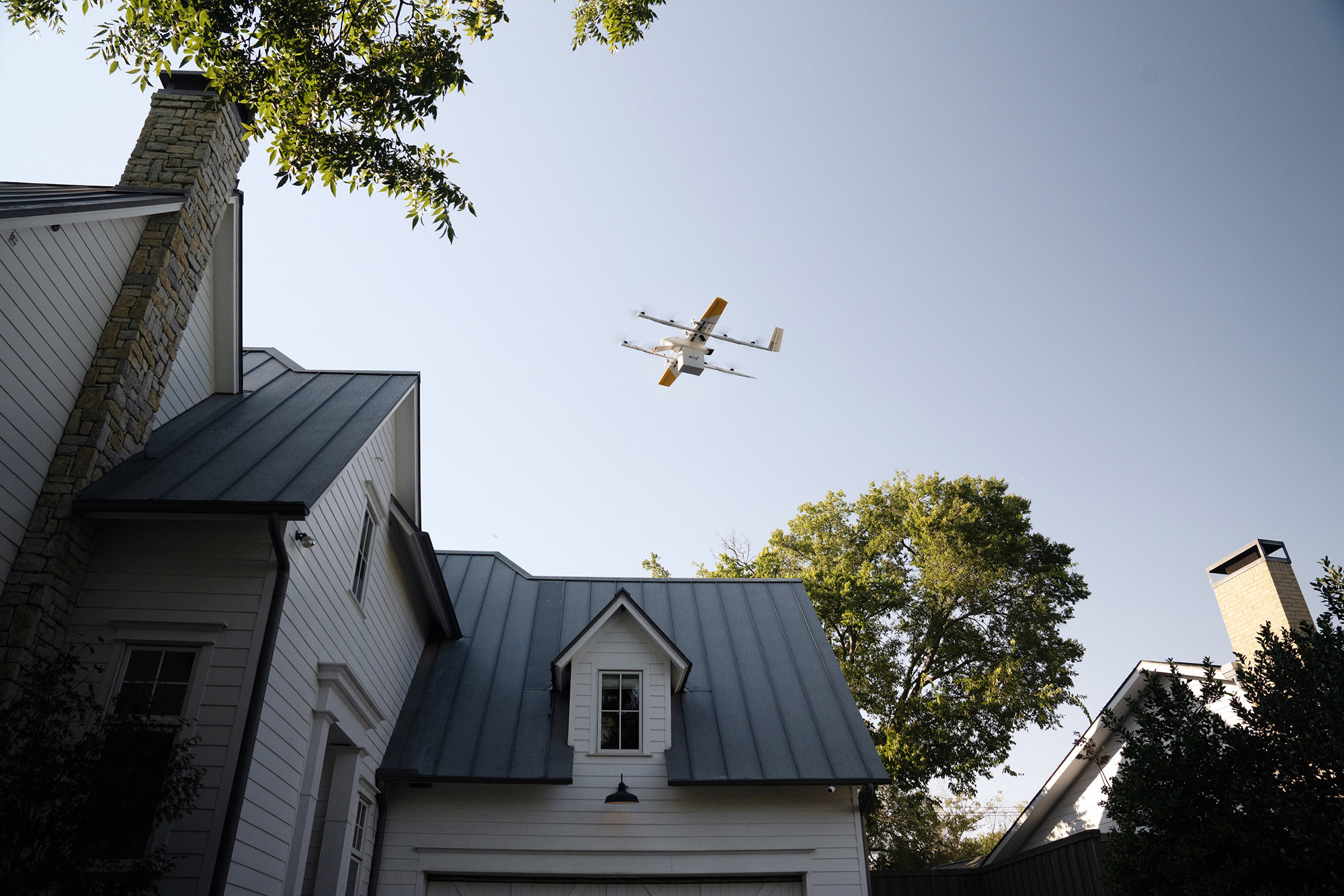
Walmart and Alphabet's Wing — already the largest retail drone delivery network in the US — switched on service across Greater Orlando, returning to Florida after a hiatus of nearly two years. Initial coverage runs from stores in Apopka and Clermont, reaching over 5,000 homes and businesses with deliveries in as little as 30 minutes, before extending to Ocoee and Haines City.
The Orlando launch is one step in a much larger build-out: 270-plus Walmart stores by the end of 2027, a network Wing describes as coast to coast, ultimately covering around 10% of the US population.
The usage data is the part worth filing. Wing reports that its top quartile of customers order three times a week — and the basket is groceries, not gadgets: eggs, ground beef, tomatoes, snacks. Repeat behaviour at that frequency is the first credible evidence that drone delivery has found a habit, not a novelty.
Flytrex admits what the weather won't
The quietest of the three announcements may be the most operationally honest. Flytrex and logistics platform Nash launched an autonomous-first, multi-modal system across every Flytrex site in Dallas-Fort Worth: orders route to drones by default, and fall back to on-demand ground drivers when weather, payload or airspace rules them out.
It is an acknowledgement the industry has resisted for years — that a drone network with no ground fallback is a service that randomly stops working. Multi-modal routing turns aerial delivery from a weather-dependent experiment into a dependable SLA.
What to watch
Three things over the next two quarters: whether DoorDash names a launch market and publishes anything about fleet size; whether Wing's larger five-pound-payload aircraft, now flying commercially, shifts the basket beyond convenience items; and whether any operator starts disclosing the numbers that matter — cost per delivery, sorties per aircraft per day, and intervention rates. Certification was the easy part to announce. The economics will be the hard part to hide.
Cite this article
Rob Polli. "Sector briefing: drone delivery just had its most consequential week." Autonomous Systems Review, 6 Aug 2026. https://autonomoussystemsreview.com/articles/sector-briefing-drone-delivery-just-had-its-most-consequential-week.