Sector briefing: under the ice, maritime autonomy meets its hardest exam
No GPS, no comms, no rescue: polar science has quietly become the proving ground for autonomous underwater vehicles — and the lessons flowing out of Greenland and Antarctica are the same ones navies are paying for.
This month a fleet of autonomous marine robots is working the fjords of south-east Greenland from the deck of the RRS Sir David Attenborough. The six-week expedition — part of GIANT, a five-year programme led by the British Antarctic Survey and funded by the UK's Advanced Research and Invention Agency — pairs the ship's own survey work with airborne drones, satellite sensing and autonomous underwater vehicles sampling water no crewed platform can safely approach.
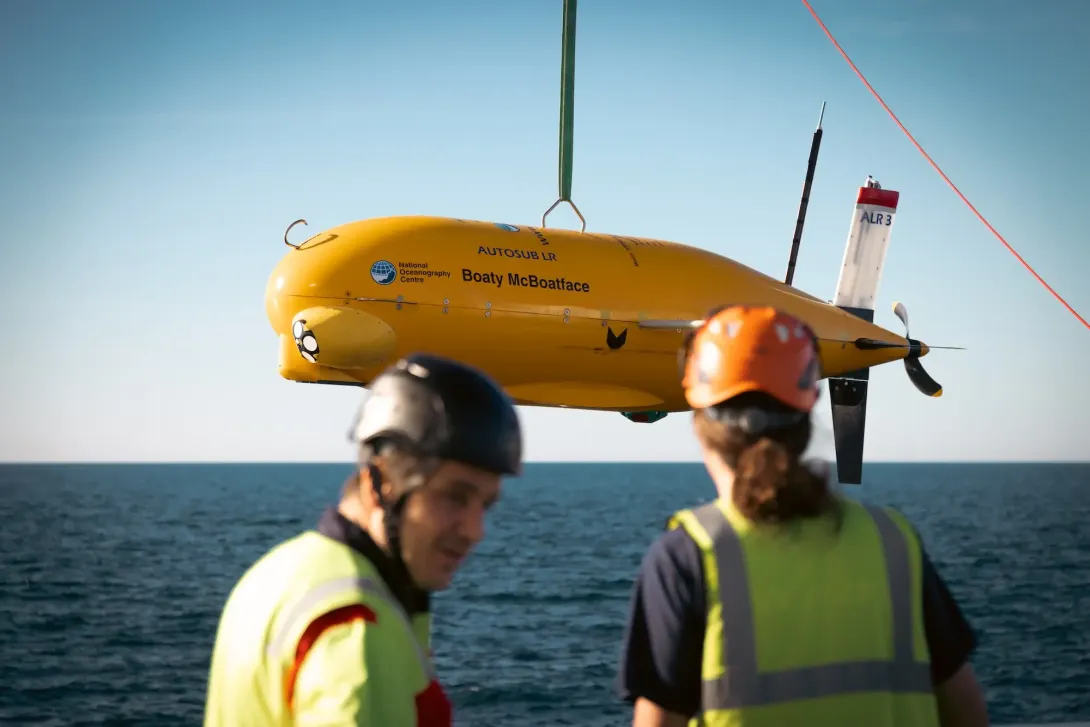
The star of the fleet is the most famous robot in Britain. Boaty McBoatface, the National Oceanography Centre's Autosub Long Range, will dive 1,500 metres beneath the ice mélange — the dense slush of sea ice and calved bergs that clogs Greenland's fjords and acts as a brake on the glaciers behind it — to map its underside for the first time.
The reason this work belongs to robots is simple, and it is the reason this sector matters far beyond climate science.
> [QUOTE] "The glacier front is so unpredictable and dangerous." — Dr Pierre Dutrieux, British Antarctic Survey
Ice cliffs up to 100 metres tall calve into the water with little warning. The environment ahead of a tidewater glacier is, in operational terms, a denied area: no place for a crewed vessel, no GPS once submerged, no radio link under the ice, and no realistic prospect of rescue if something fails. It is the most demanding operational design domain on Earth — and autonomous systems are now routinely working in it.
What operating under ice actually requires
Everything that makes commercial maritime autonomy hard is amplified here. Navigation runs on dead reckoning, inertial units and acoustic positioning — Sonardyne kit features on the current expedition — because satellite fixes are impossible beneath the ice. Endurance is measured in weeks: the vehicle must carry its energy, make its own decisions from sonar returns, and find its way back to a hole in the ice or an open-water rendezvous. Every mission is flown against the possibility that the vehicle simply does not come home.
That is not a hypothetical. Ran, the University of Gothenburg's Kongsberg HUGIN, spent 27 days and over 1,000 kilometres beneath Antarctic ice producing the first map of a glacier's underside — then was lost on a return campaign. Boaty itself logged more than 70 hours inside the cavity beneath the Dotson Ice Shelf across four missions, surveying a space no human vehicle has entered. In this sector, vehicle loss is not a scandal; it is a budgeted line item, priced against data that cannot be obtained any other way. Commercial autonomy, with its zero-tolerance safety cases, could learn from the honesty of that accounting.
The defence crossover
The same physics that makes under-ice science hard makes undersea warfare autonomous. Navies are moving fast on uncrewed underwater vehicles — the US has fielded a containerised combat UUV and demonstrated launching an underwater drone from a submerged allied submarine — and the supplier base overlaps almost entirely with the science fleet: Kongsberg's HUGIN line (a deeper-rated successor is due winter 2026/27), the NOC's Autosub family, and the acoustic navigation specialists who serve both markets. Every under-ice science campaign is, functionally, an endurance and autonomy trial that defence procurement gets to read for free.
Why the data matters
The stakes attached to these missions are not academic. BAS puts the sea-level contribution of a full West Antarctic ice sheet collapse at close to eleven feet. The only instruments that can measure how fast the underside of that ice is melting are autonomous ones. Watch for three things this season: whether the mélange mapping comes back intact, glider fleet expansion around the Antarctic Peninsula's research stations, and the specification of Kongsberg's next-generation HUGIN — the clearest public signal of where deep, long-endurance autonomy is heading.
Cite this article
Rob Polli. "Sector briefing: under the ice, maritime autonomy meets its hardest exam." Autonomous Systems Review, 2 Aug 2026. https://autonomoussystemsreview.com/articles/sector-briefing-under-the-ice-maritime-autonomy-meets-its-hardest-exam.