Sector briefing: how a five-year-old British boatmaker ended up arming three navies
Kraken Technology's uncrewed surface vessels are heading to the Royal Marines, US Special Operations and — via a Rheinmetall joint venture — the German line. The company's rise is a case study in how maritime autonomy became NATO's fastest-moving procurement story.
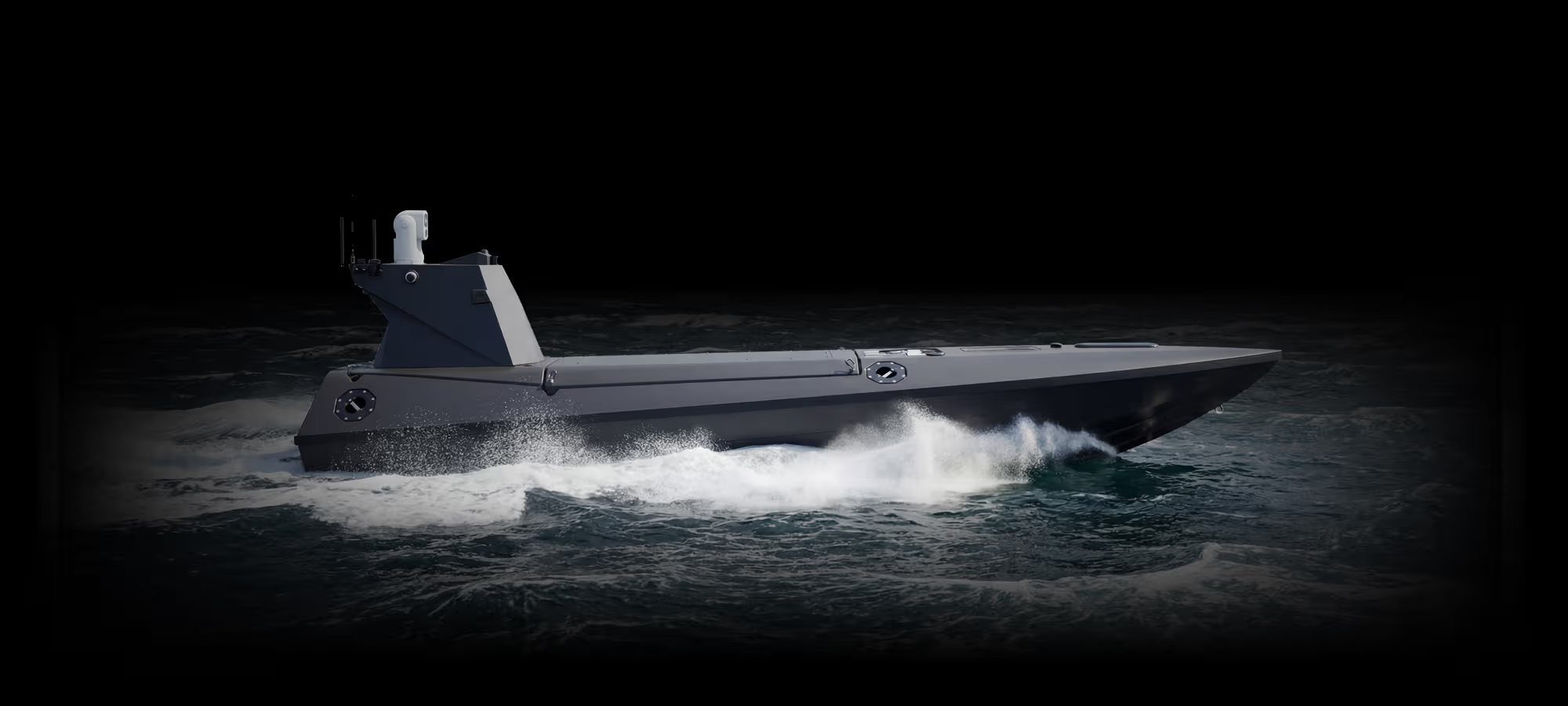
Five years ago Kraken Technology Group did not exist. Today the Fareham-based company is supplying uncrewed surface vessels to the Royal Navy, US Special Operations Command and, through a joint venture with one of Europe's largest defence primes, the German military. That trajectory tells you almost everything about the state of maritime autonomy in 2026.
The contracts
The anchor deal is domestic: a £12.3 million Royal Navy contract for 20 K3 Scout uncrewed surface vessels, destined for the Coastal Forces Squadron and 47 Commando Royal Marines, to be used for operations, training and the development of autonomous and uncrewed doctrine. It is a modest sum by naval-procurement standards, and that is precisely the point — USVs deliver capability at a fraction of the cost and none of the crewing risk of a conventional hull.
The international expansion is where the story accelerates. In November 2025 Kraken secured a $49 million Other Transaction Authority contract from US Special Operations Command for surface and subsurface vessels aimed at ISR and direct-action missions in contested littoral waters. Then, in April 2026, US defence-tech firm Anduril partnered with Kraken to supply small USVs to the US Navy. And the K3 Scout is now being built in Germany too, under the Rheinmetall Kraken GmbH joint venture — a British startup's design entering series production through a European prime's industrial base.
Three navies, two continents, one five-year-old company. That is not normal defence-procurement tempo.
Why maritime autonomy, why now
The demand signal is strategic and unambiguous. The UK and Northern Europe are struggling to hold their waters against Russian naval activity in the North Atlantic and Baltic, with particular concern for the undersea cables and pipelines that carry the continent's data and energy. The British government has acknowledged the Royal Navy could shadow an adversary submarine near those cables for only about a month — a capability gap that crewed vessels cannot close affordably.
Uncrewed surface and subsurface vessels are the answer the sector has converged on: persistent, low-cost, low-risk platforms that can watch, patrol and screen without putting sailors to sea. The 2025 UK Strategic Defence Review made the doctrine explicit, recommending integrated crewed-uncrewed-autonomous frigate forces for anti-submarine warfare — a formal signal that USVs are moving from experiment to order of battle.
The market data matches the doctrine. GlobalData projects that uncrewed underwater vehicles alone will account for more than 40% of the global uncrewed maritime vehicles market, and the recent defence exhibitions — UDT, Eurosatory — have been dominated by autonomy, ISR payloads and the counter-jamming technology that keeps these platforms working when their communications are contested.
The pattern worth noting
Kraken's rise fits a template ASR readers will recognise from the XTEND merger and the FCC's supply-chain moves: defence autonomy is consolidating around trusted, allied industrial bases, and the winners are agile firms that can move faster than primes but plug into their manufacturing and procurement reach. The Rheinmetall JV is the tell — the future of European defence autonomy looks like startup design married to prime-contractor scale.
What to watch
Three things. First, whether the K3 Scout's Royal Navy deployment produces published operational data — endurance, autonomy level, intervention rates — or whether defence secrecy keeps the numbers that matter out of view. Second, the Anduril relationship: whether it stays a supply arrangement or deepens into the kind of software-plus-hardware integration reshaping the sector. Third, subsurface — the UUV segment is the larger prize, the harder engineering problem, and the one most directly aimed at the undersea-cable threat that is driving European naval spending. Maritime autonomy has found its wartime rationale. The procurement is now moving faster than the doctrine to govern it.
Cite this article
Rob Polli. "Sector briefing: how a five-year-old British boatmaker ended up arming three navies." Autonomous Systems Review, 7 Aug 2026. https://autonomoussystemsreview.com/articles/sector-briefing-how-a-five-year-old-british-boatmaker-ended-up-arming-three-navi.